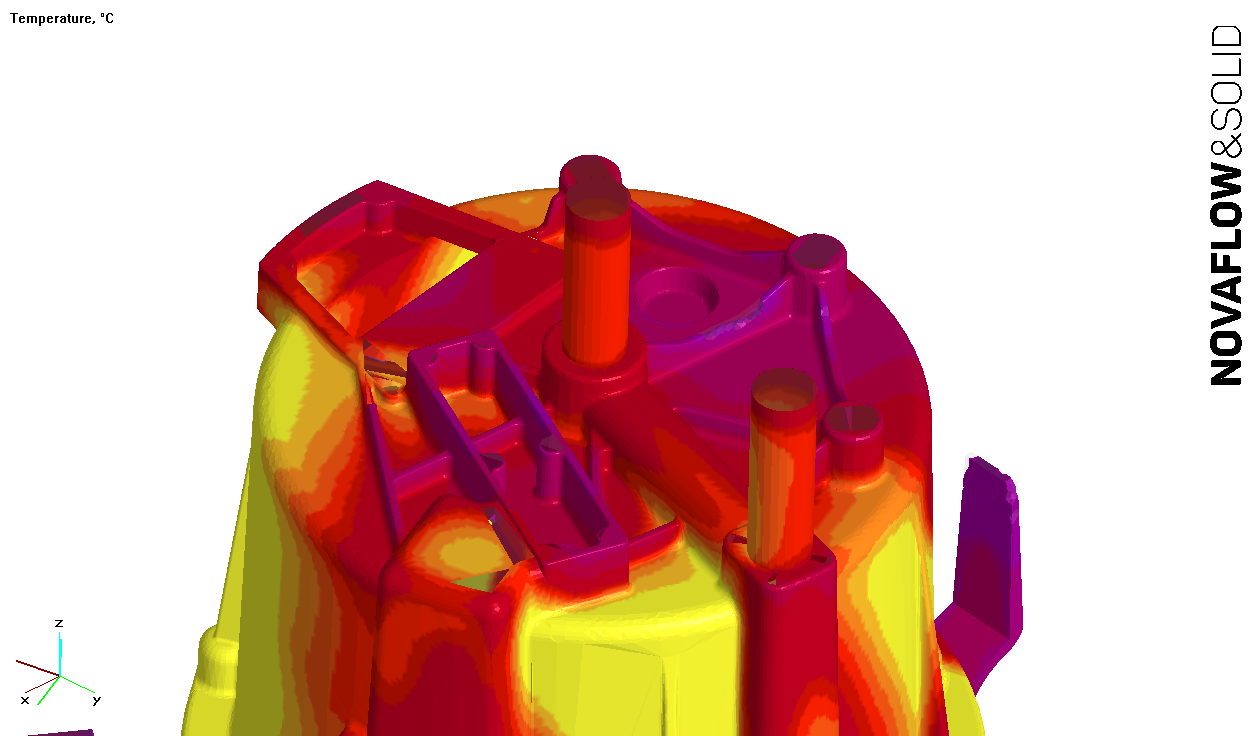
Casting simulation is deterministic. If the geometry, material properties, and boundary conditions are unchanged, the simulation will always predict the same result.
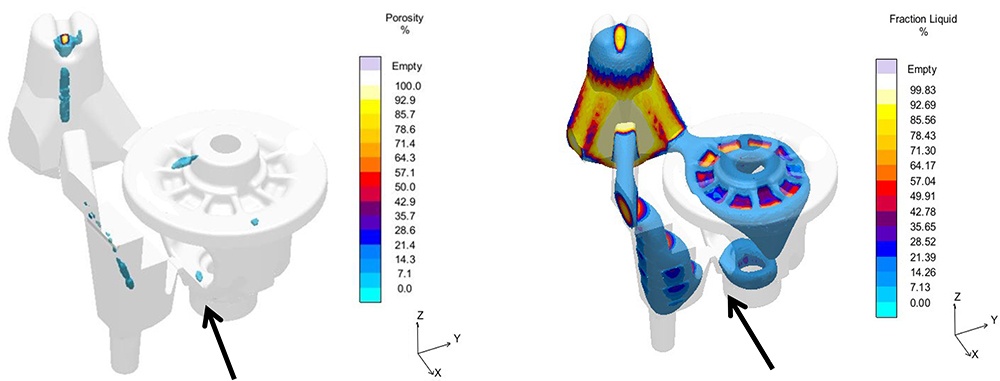
The fill pattern will be the same. The solidification path will be the same. The last-to-freeze location will be the same. The predicted shrinkage will be in the same place every time.
Yet in production, defects move. Shrinkage appears in different locations. Shrinkage comes and goes. A casting that ran well yesterday suddenly shows feeding problems today.
When this happens, the usual response is to question the simulation. In most cases the simulation is not wrong, but the operator is in danger of going down a rabbit hole that never ends. The worst case I have seen reached sixty-eight simulation versions without solving the problem.
What actually changed was not the geometry. It was not the gating. It was not the riser. The real boundary conditions changed — just not the ones in the model.
Simulation only varies what you tell it to vary.
Two Boundary Conditions That Change Constantly in Production
In most aluminum sand casting processes, the two largest sources of variation are: liquid metal quality and mold and core thermodynamics. Both strongly affect shrinkage formation. Both are usually misrepresented, or treated as constant, in simulation.
Liquid Metal Quality Changes the Stress Required for Shrinkage to Form
During solidification, the remaining liquid metal is placed under tensile stress. Liquid metal can tolerate a surprising amount of stress before cavitation occurs, so shrinkage does not form immediately when feeding becomes restricted. A void forms when the stress exceeds what the liquid can sustain, or when a nucleation site is available.
That nucleation site is usually created by defects already present in the liquid metal: Oxide films created during turbulent filling or melt handling (Bifilms), inclusions from melt handling or contaminated returns, gas content variation.
When the metal is clean, the stress required to form shrinkage is higher. When the metal is damaged, shrinkage forms more easily and may appear in different locations.
Simulation assumes constant metal quality. Production rarely has it.
Mold and Core Thermodynamics Are Not Constant
Casting models typically use fixed or temperature-dependent heat transfer coefficients based on assumed mold and core properties. These coefficients are treated as consistent numbers. In real production, molds and cores are rarely consistent enough to justify that assumption.
Upstream variations in core making and molding can significantly change thermal behavior even when the casting surface looks acceptable. We all see molds or cores that look questionable at the edges or in the core print areas, but they still get used — often with the best of intentions — because the surfaces forming the casting appear acceptable.
The problem is that heat transfer depends on internal structure, not just surface appearance. Typical sand cores and molds have a close pack fraction in the range of 0.5 to 0.7, meaning 30–50% of the volume is air. Simulation data files can be adjusted to represent a given media, but what happens if part of the mold or core has a close pack fraction of 0.3 or 0.4 due to poor compaction or blowing?
The change in thermal conductivity can be extreme. That change alters the local cooling rate. The last-to-freeze location moves. Feeding that worked in the simulation may no longer be sufficient. The defect moves — and gets called random.
When Defects Move, the Physics Didn’t Change — The Physical Conditions Did
When shrinkage appears to move around, the cause is usually one of the following: Metal cleanliness changed, core density changed, mold compaction changed, coating thickness changed, pouring conditions changed or temperature changed.
If those variables are not part of the model, the simulation will always look stable while the process is not.
Shrinkage does not choose a location at random. It forms where the liquid is weakest and where the thermal conditions allow.