
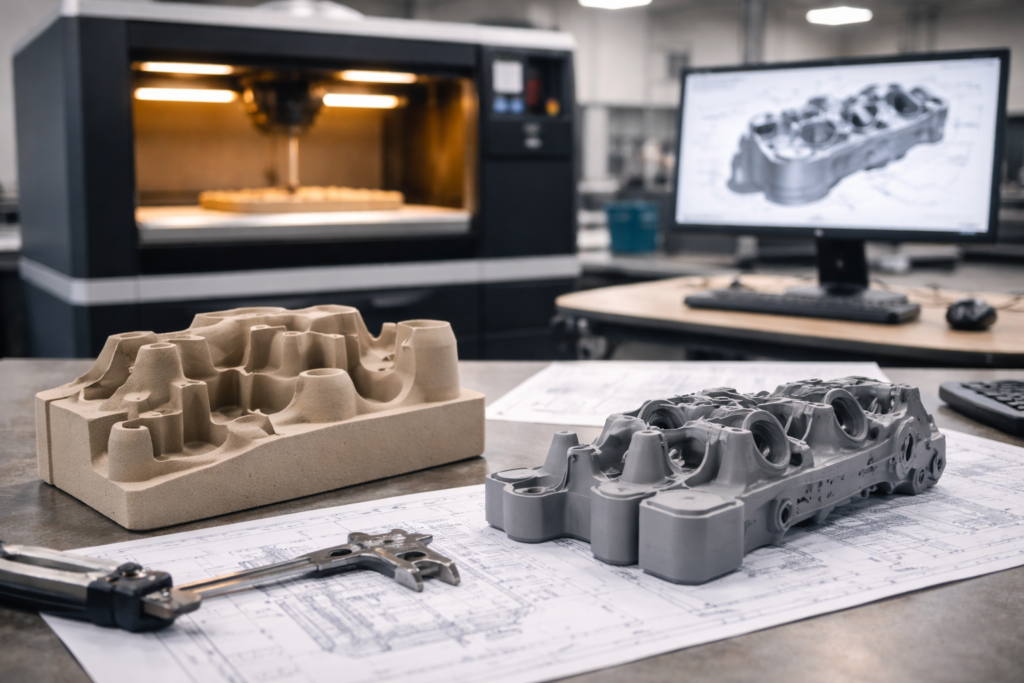
Design for Sand Printing
Binder jet sand printing has changed what is possible in metal casting, particularly for complex internal geometries, prototype development and low-volume production. However, successful implementation requires more than simply printing existing core designs.
Designing for sand printing requires a process-driven engineering approach that considers manufacturability, handling robustness, gas evolution, assembly strategy, filling behaviour and long-term industrialisation. Features that are technically printable are not always practical, stable or commercially viable in production environments.
Metal Casting Development provides engineering support focused on adapting castings, core systems and mold concepts specifically for binder jet sand printing processes while maintaining a clear pathway toward repeatable manufacturing and future production tooling.
Designing Beyond Printability
Successful sand printed tooling design is not simply about whether a geometry can be printed. The wider casting process must still function robustly.
Considerations include:
- Core handling and transportation robustness
- Core distortion and dimensional stability
- Core package assembly complexity
- Gas generation and venting strategy
- Mold filling behaviour and flow stability
- Cleaning and depowdering accessibility
- Thermal balance and solidification behaviour
- Casting yield and process efficiency
- Inspection and datum accessibility
- Transition to future hard tooling production
The objective is not simply to produce printable geometry, but to create casting solutions that are practical, repeatable and scalable.
Core Consolidation & Assembly Reduction
One of the major advantages of sand printing is the ability to consolidate multiple conventionally assembled cores into larger integrated core structures.
Reducing assembly interfaces can:
- Improve dimensional consistency
- Reduce mismatch and assembly variation
- Eliminate core shift accumulation
- Simplify mold preparation
- Reduce assembly labour
- Improve process repeatability
However, larger compounded cores introduce additional considerations including handling strength, distortion risk, gas evacuation and thermal behaviour. Engineering trade-offs must be evaluated carefully rather than simply maximising consolidation.
Gas Evolution & Venting Strategy
Sand printed molds and cores can generate significant gas volumes during pouring due to binder systems and increased printed surface area.
Without proper engineering consideration this can contribute to:
- Gas porosity
- Mold pressurisation
- Surface defects
- Misruns
- Localised erosion
- Reduced casting integrity
Gas management strategy should be considered from the beginning of the design process, including:
- Vent path integration
- Core segmentation strategy
- Binder selection considerations
- Filling direction and flow control
- Metal velocity management
- Thermal loading
- Core print orientation where applicable
The casting process and the printed tooling design cannot be separated.
Designing with Future Industrialisation in Mind
Sand printing is often used during development, prototype and pre-production phases, but early engineering decisions can strongly influence the viability of later production tooling.
Design intent should consider:
- Future hard tooling conversion
- Core box feasibility
- Tool split strategy
- Draft and extraction limitations
- Production cycle time implications
- Long-term process stability
- Production cost structure
Features that are beneficial during prototype development may become impractical for serial production if long-term industrialization is not considered early.
A robust development strategy balances the flexibility of additive manufacturing with realistic pathways toward repeatable production processes.
Casting Process Engineering Integration
Printed tooling does not eliminate traditional casting process requirements. In many cases, the increased design freedom makes process engineering even more critical.
Metal Casting Development supports:
- Gating and filling system design
- Bottom pouring concepts
- Flow stability optimisation
- Oxide entrainment reduction
- Casting simulation support
- Core and mold package design
- Process robustness evaluation
- Design for Manufacture (DfM)
- Prototype-to-production transition strategy
The objective is to combine additive manufacturing flexibility with disciplined casting engineering principles to produce stable, manufacturable and commercially viable casting solutions.
From Prototype Freedom to Production Reality
Sand printing enables new possibilities in casting design, but successful implementation requires more than geometric freedom alone. Process stability, metallurgical integrity and long-term manufacturability remain critical.
Metal Casting Development provides engineering-led support focused on integrating sand printing technologies into practical casting manufacturing strategies for prototype and production applications.