
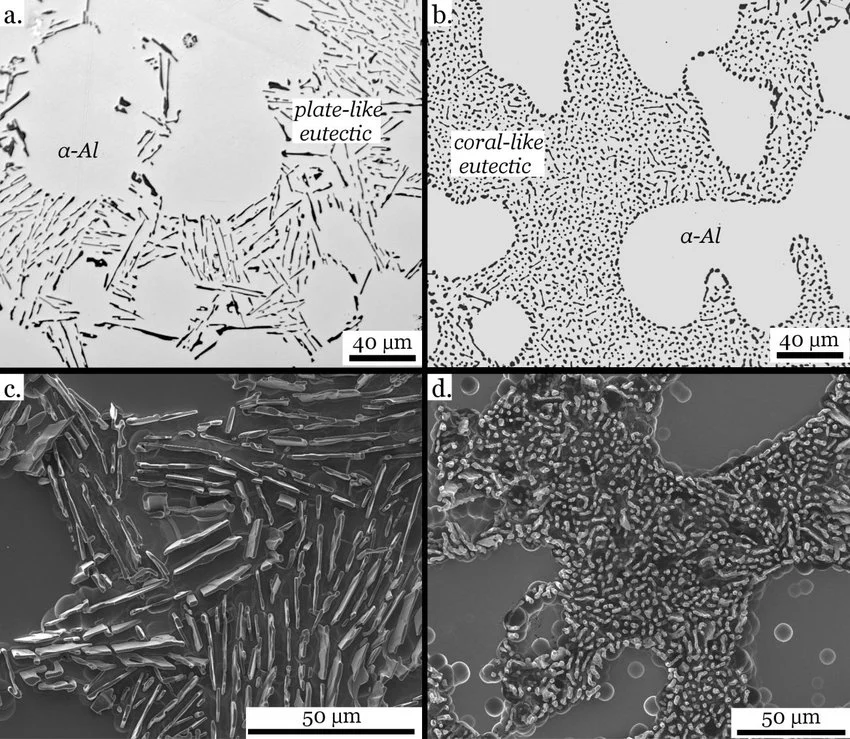
Porosity has long been one of the most persistent quality challenges in aluminum castings. While macro-porosity can often be identified and removed, micro-porosity—tiny voids dispersed within the casting—poses a more insidious threat, reducing mechanical strength, fatigue resistance, and leak tightness. Among the many factors influencing porosity, the addition of Strontium (Sr), a widely used eutectic modifier in Al–Si alloys, plays a complex and sometimes contradictory role.
Why Strontium Is Added
Strontium is commonly introduced (typically 50–250 ppm) into Al–Si casting alloys to modify eutectic silicon morphology. Without modification, silicon plates solidify in coarse acicular structures that make castings brittle. With Sr, silicon refines into a fine fibrous network, improving ductility, machinability, and toughness.
The Link Between Sr and Micro-Porosity
While Sr improves silicon morphology, its influence on porosity is less favorable in many casting conditions:
Increased Porosity Levels
Numerous studies show that Sr modification tends to increase porosity volume fraction compared to unmodified alloys. For example, Wang et al. (2019) found that Sr-modified A356 castings had higher porosity and lower density as Sr content increased. Similarly, 3D imaging of Al–Si alloys revealed that Sr additions raised porosity by ~10 % compared to unmodified alloys.
Hydrogen Bubble Nucleation
Sr alters the nucleation and stability of hydrogen bubbles. Lee & Sridhar (2002) demonstrated that Sr promotes more stable pore nuclei, meaning porosity begins earlier during solidification and more voids survive to the final structure.
Effect on Oxide Films (Bi-films)
Sr segregates into oxide films as SrO, fracturing the Al₂O₃ surface and forming cracks and inclusions. These defects act as new nucleation sites for porosity. Bi-film entrapment becomes more problematic in Sr-modified melts unless filtration and fluxing are carefully applied.
Solidification Behavior
Sr depresses the eutectic temperature of Al–Si alloys, increasing the mushy-zone solidification time. This extended window allows pores more time to grow and increases the likelihood of inter-dendritic porosity if feeding and degassing are not optimized.
When Sr Can Reduce or Redistribute Porosity
Not all studies agree that Sr always worsens porosity. In some cases:
Higher-Si Alloys
Callegari et al. (2023) found that while Sr increased porosity in pure Al and Al-1 %Si, it reduced porosity in Al-9 %Si alloys. In all cases, Sr reduced average pore size, sometimes producing finer, more evenly distributed porosity.
Melt Control as the Key Variable
With effective degassing, filtration, and feeding design, foundries can mitigate Sr’s porosity-promoting tendencies and retain its silicon-refining benefits.
Foundry Practice Implications
For foundries, the message is not to avoid Sr, but to balance its benefits with stricter melt control:
Hydrogen Management: Aggressive degassing (argon or nitrogen rotary degassing) becomes even more critical in Sr-modified alloys.
Oxide Reduction: Ceramic foam filters and fluxes should be standard practice to minimize bi-film-related porosity and utilize well designed bottom poured gating systems.
Careful Additions: Over-modification provides no extra silicon refinement but worsens porosity.
Method Design: Since Sr alters the solidification range, riser systems need to be well designed and provide good directional solidification. Gating designs must utilize good bottom pouring techniques to minimize turbulence.
Conclusion
Strontium modification has proven value in refining silicon morphology and improving ductility in Al–Si alloys. Multiple studies confirm that it often increases micro-porosity through mechanisms linked to hydrogen bubble nucleation, oxide film disruption, and extended solidification intervals. Foundries that use Sr must therefore apply tighter hydrogen control, improved running practices, and optimized feeding practices to balance silicon modification benefits with porosity risk.
Further Reading.
- Wang, Hao, Yu, et al. Effect of Strontium Modification on Porosity Formation in A356 Alloy (2019).
- Lee, P.D. & Sridhar, S. Effect of Strontium Modifiers on Porosity in Cast Al–Si Alloys (2002).
- Lee, P.D. et al. Direct Observation of the Effect of Strontium on Porosity Formation (2000).
- Callegari, M. et al. Influence of Alloying Elements on the Microstructure and Porosity of Al–Si Alloys (2023).
- Li, Z. et al. 3D Imaging and Quantification of Porosity and Intermetallic in Al–Si Alloys (2018).