What We Mean by 3D Printing
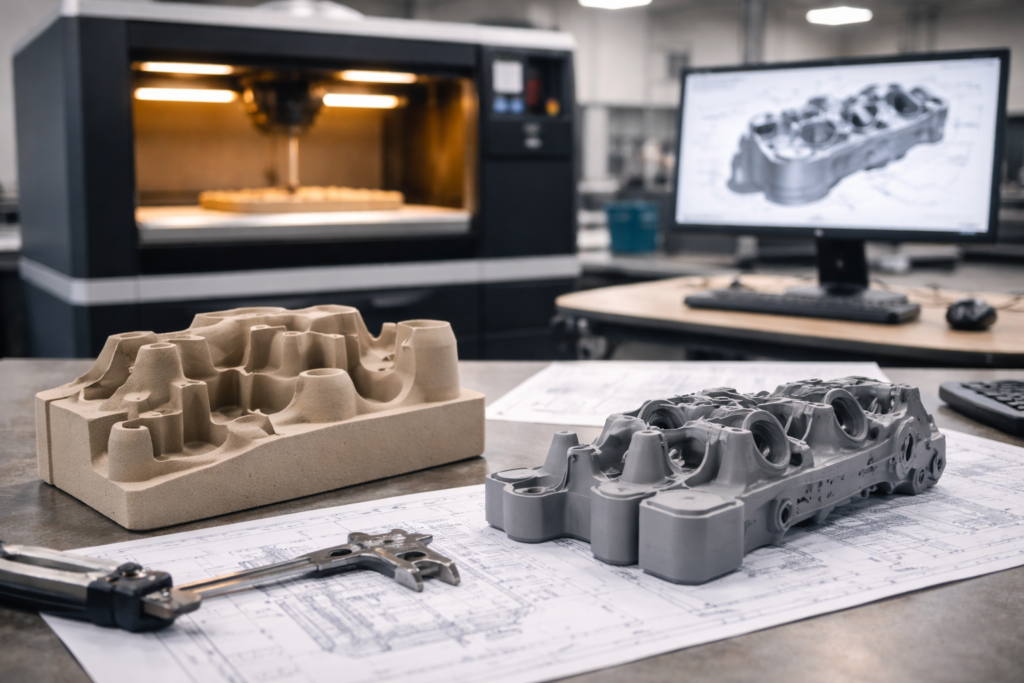
3D printing at Metal Casting Development LLC is a development and manufacturing support tool, not a stand-alone product.
We use additive manufacturing to accelerate casting design validation, tooling development, and process optimization, reducing risk before committing to permanent tooling or production processes.
Our focus is on function, manufacturability, and process learning — not cosmetic prototypes.
Where 3D Printing Adds Real Value
Engineering-driven applications include:
- Prototype tooling and geometry validation
- Printed sand cores and molds for early trials
- Gating, runner, and riser development
- Assembly, packaging, and clearance checks
- Design iteration before hard tooling release
These applications allow faster iteration, earlier problem detection, and better decisions upstream, where changes are least expensive.
Integrated with Casting & Process Engineering
Unlike service bureaus that simply “print files,” MCD integrates additive manufacturing directly into:
- Casting method design
- Gating and filling strategy development
- Tooling concepts and feasibility reviews
- Program launch and production readiness
3D printing is used in context, supporting real foundry processes and manufacturing constraints.
Not a Print Shop — An Engineering Tool
MCD does not compete on print speed, color options, or volume pricing.
Instead, we provide:
- Engineering judgment on what to print and why
- Design changes that improve printability and castability
- Feedback loops between printed parts, trials, and process refinement
This ensures printed components contribute meaningful insight — not just physical models.
Use 3D Printing to Reduce Risk — Not Just Make Parts
If you’re considering additive manufacturing as part of a casting or tooling program, we can help determine where it adds value — and where it doesn’t.
Typical Use Cases
3D printing is most effective when applied to:
- New casting architectures or complex geometry
- Prototype or low-volume development programs
- High-risk cores or internal features
- Programs requiring rapid iteration before tooling release
- Supplier or foundry capability evaluation
Supporting Production — Not Replacing It
Additive manufacturing is not a substitute for robust production processes.
Used correctly, it:
- Reduces development time
- Improves launch confidence
- Prevents expensive tooling rework
- Supports better supplier alignment
Used incorrectly, it simply adds cost.
Our role is ensuring it is used correctly.